We at Garments Without Guilt are continuing to highlight individuals who have set the world ablaze (pun intended!) with their dogged determination in helping to uplift the lives of those in need. (A quick apology to all you budding arsonists who might have come to this post having been misled by the title.)
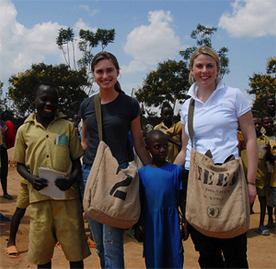
Lauren Bush & Ellen Gustafson
(photo from Feedprojects)
It all started with a bag. In 2006, Lauren Bush (a well-known model at the time) designed the FEED 1 bag in partnership with the United Nations World Food Programme (WFP). From its humble beginnings, the bag soon became an inspirational symbol of how a simple idea can help change the world.
Writing for Ecouterre, Lauren explains how FEED Projects got started:
“I helped start FEED Projects in 2006 as an “accidental” business. FEED’s true mission was to sell the FEED 1 bag, which feeds one child in school for one year through the United Nations World Food Program. Once it became obvious that the UN could not sell the bag itself to raise money and awareness, my business partner, Ellen Gustafson, and I decided the best route would be to start our own company.”
Social networking for good was the topic of an earlier post, “Can Giving In to Eco Peer Pressure be Good?”, and we’ve just discovered a new one for you to add to the list of online friends-Changents.com. It’s a clever combo of the words CHANGE and AGENTS, just the type of people they are interested in.
They say they’re about “Connecting Agents of Change with a fan base of backers around the world.”
“Change Agents are the innovators of social and environmental change who need your help.
Backers team up with Change Agents to create real change.”
From their About page:
Changents connects Agents of Change with a fan base of Backers around the world, enabling them to create change together.
Change Agents are the rock stars of social change. They’re the people who put it on the line everyday to get it done. And there are lots of “super fans” out there who want to get into the act by backing Change Agents and propelling their efforts forward.
From The Washington Post:
With the advent of online social networks and instant connectivity, tracking your individual impact "is sort of the narcotic of the new generation of philanthropy," said co-President Alex Hofmann. "You can forward a story, you can post the story. We call it 'rippable.' When people respond, your ripple begins to grow."
The company, run primarily by its two founders based in Alexandria, Va., and Boston, is working to monetize, through online advertising and corporate sponsorships, a forum where 20- and 30-year-olds can network to build a better society.
"People want to feel that the actions that they're taking are tangible," said Hofmann. "Sending 10 bucks to the United Way at the end of the year" is good, but people may "not be sure where it goes… They want to see and understand [the impact of] their actions."
Treehugger says they’ve “noticed an increasing range of sites dedicated to social networking for those of us interested in social and environmental change.”
So check them out and find out how you can be a rock star change agent!
These days, the power of peer pressure is working to the environment’s advantage. Check out this Ford commercial that uses the concept of teen peer pressure to get parents to want to buy a hybrid.
Then it seems the eternal pressure for men to impress the ladies is working for the planet too. In an article entitled “Eco-Geeks Get All The Girls“, a study conducted by car maker GM found that:
88 percent of women say they'd rather chat up someone who owns the latest fuel-efficient car than the latest sports car
And
45 percent of 18- to 43-year-olds say it's a fashion faux pas nowadays to have a car that's not green or environmentally friendly.
With the popularity of social networking sites, new websites are popping up to drive the green point home too, such as:
Greenopolis.com, where an online quiz helps you see how green you are and assigns you a badge, then helps you earn points toward a greener badge by participating in the site.
Do The Green Thing.com, “a new community that makes it easy and enjoyable to be a bit greener. Every month you'll get a different Green Thing to do. All you have to do is do it.”
Other sites offer a selection of information, goods and services to make your choices easier, like:
Treehugger.com-which helps you to get informed, interact and take action!
Evo.com provides a selection of green products, services, and information all in one place. From hybrid vehicles to apparel to home furnishings, their goal is to make it easy for you to make greener choices every day.
And then you can join the We Campaign, a project of The Alliance for Climate Protection — a nonprofit, nonpartisan effort founded by Nobel laureate, former Vice President and everyone’s favorite environmentalist, Al Gore. By signing up on his website We Can Solve It.org, you can add your voice to the over one million people speaking up for solutions to global warming.
So there are many ways that you can finally give in to peer pressure and feel good about it! Go ahead, all the cool kids are doing it!
Of course it has, but it is an evolution that involves the way that consumers think about the world, products and services as well as the way that companies do business globally.
For the recipients of funds all over the world, it certainly makes a difference. Fair Factories.org published an article that says:
“Starbucks contributes 5 cents from the sale of each bottle of Ethos water to help children around the world get clean drinking water. IKEA donates $2 from the sale of specific stuffed animals to help children recovering from armed conflicts in Angola and Uganda. Target offers a First Aid and Emergency Preparedness Kit and gives $10 from each $30 kit to the Red Cross.”
For children drinking clean water, being comforted through the trauma of armed conflict and being rescued from emergency situations around the world, ethical trading and CSR has made a huge difference.
Customers feel better and their feelings are reflected in product sales. The same Fair Factories’ article also mentions Dove’s campaign for real Beauty (shown in the video above.)
“After launching its Self Esteem Fund this year with a $50,000 donation and campaign about real beauty, Dove saw sales of products in its ads skyrocket 600 percent.”
And this new way of doing business is creating opportunities for start up companies consultants and specialist organizations. The Fair Labor Association in the U.S. tells us:
“Since 1999, the Fair Labor Association (FLA) has helped improve the lives of hundreds of thousands of workers by holding companies accountable to the FLA Workplace Code of Conduct, inspecting and monitoring factories around the world, and developing innovative, sustainable solutions to labor abuses. Fair Labor Association (FLA) affiliates are dedicated to protecting the rights of workers around the world. They include colleges and universities, socially conscious companies, and human rights, civil society, and other non-governmental organizations (NGO's).”
In the UK, according to an article in New Consumer.com:
“SEE Potential, a pioneering organisation set up to track ethical business practice, has revealed that over half of UK managers say CSR has a valuable role to play in business. Forty-nine per cent of managers also said their company could generate new business by having genuine social, environmental and ethical policies (SEE) in place. An impressive 62% said that SEE policies enabled them to retain staff more easily, and just over a third said that having SEE policies even helped them cut costs.”
Organizations and companies are even banding together, as in the case of the Fair Factories Clearinghouse (FFC), a non-profit, collaborative industry initiative to manage and share audit information between companies.
So the trend toward ethical and socially responsible business practices is making a big difference, and promises to continue to do so.
If you don’t feel a difference, what changes could you make to reap the benefits?
As Bono said in the video we posted earlier, philanthropy is different from CSR. But as Matthew Bishop, US Business editor of The Economist explains to Asian economic correspondent Thomas Crampton in the video posted above, philanthropy is generally chosen by the wealthy, so whether it’s a corporation or a wealthy person, it does not involve community input. Though both are involved in making a positive impact, only CSR puts the power in the hands of the customers and stakeholders.
Philanthropy/Corporate Contributions are donations of funds, time, resources, and in-kind services by companies to charitable, non-profit, and/or community initiatives with the intention of “giving back” from profit for the greater common good.
Whereas:
Corporate Social Responsibility (CSR)aligns business operations with social values. CSR integrates the interests of stakeholders-all of those affected by a company’s conduct-into the company’s business policies and actions. CSR focuses on the social, environmental, and financial success of a company-the triple bottom line, with the goal being to positively impact society while achieving business success.
The difference is in giving for the sake of giving, with perhaps the benefit of some PR, versus doing business to make money in a way that has a positive impact on the world at the same time-certainly a more sustainable model.
In the old model, philanthropy could be used to attempt to offset the damage done to a company’s image by its business decisions, whereas CSR involves simply doing better business.
In a discussion on Intel’s website: Where Does Philanthropy Fit in the CSR Spectrum? the moderator of CSR@intel, Dave Stangis said of CSR “That’s not just writing checks - that’s strategic investment in community and human potential.”
Comments to the post brought up interesting issues such as,
“Corporate philanthropy is distinct from corporate responsibility. Philanthropy is what you do with your profits. CSR is how you make those profits. Few companies are going to have a strategic business interest in helping the most desperate, poverty-stricken communities on this planet get their most basic needs met. And as companies steer their philanthropy into their emerging markets, they will invest less and less in those places in the world that are far from ‘emerging’ onto the global business scene.”
While an executive from Hewlett-Packard argued,
“Philanthropy is only one part of CSR… And it clearly needs to be aligned with our business and core competencies in order to have a sustainable impact.”
So basically, the old model of philanthropy is limited to the whims of the philanthropist, whereas CSR becomes part of the entire business model that allows the community to direct a company’s resources where it can do the most good and make the biggest impact on the triple bottom line.
Can a corporation be expected to do both at once? Is there enough wealth in the business world to make sure that the neediest are served? Is this the responsibility of corporations, or can it be left to governments and non-governmental organizations?
Now the colors of CSR have made ethical business fashionable. When the mainstream joins with rock stars to increase business while improving the world, the win-win-win proposition of ethical business practices makes it hard for everyone to resist. Consumers today want more than to be stylish, they, no WE want to know that our hard-earned money can be doing good on our behalf. Or at the very least, not harming our world any further.
(RED)helps raise money for The Global Fund which helps women and children affected by AIDS/HIV in Africa. By partnering with apparel giants such as GAP, Emporio Armani and Converse as well as other huge corporations, they attract customers, increase sales and consumer perception and make money as well.
Marks & Spencer’s Plan A (because there is no Plan B) has chosen the five key areas to make their business both more sustainable and kinder to the environment: Climate Change, Waste, Sustainable Raw Materials, Health and being a Fair Partner. But not only do customers get to feel virtuous, this sort of consumer-driven trend has repercussions in the supply chain, which is where Garments Without Guilt comes in. By making ethical sourcing irresistible, the lives of the factory workers and the surrounding communities are improved too.
These companies are certainly not alone. But is this just an advertising angle? Is the public merely being manipulated to increase profits? In Bono’s interview on CNN (see link above) he explained.
“We want them to make profits. We want them to get more customers, that’s the whole point. We’re not thinking in the old ways about philanthropy and we’re not wanting them to be anything other than what they are–businesses. And they have responsibilities to their shareholders. We think this will bring them more customers. We think more people will go and buy Armani. We want that. And if that happens, everyone wins here… Will there be occasionally a company that’s in this who are black-hearted and looking for a halo? Yes. Does it matter to the people who are getting the drugs? No. It’s commerce, raw commerce.”
Is this a trend being used to edge out the competition? Or is this the new standard?
Recent Comments