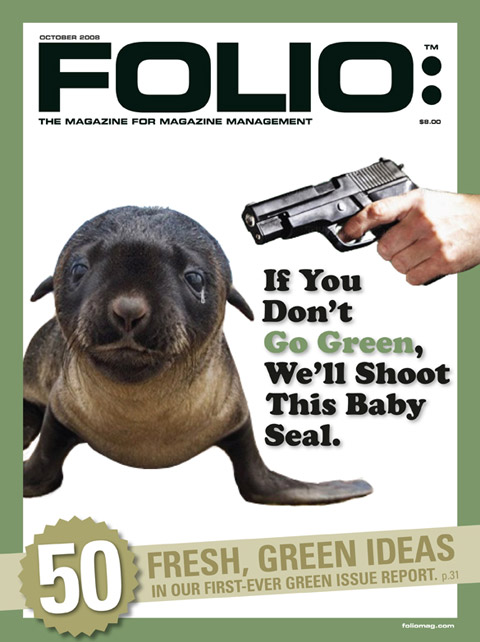
Okay, so it doesn’t exactly scream “GUILT-FREE”, but you have to admit it got your attention.
This month, Folio, a magazine about magazine publishing and an industry resource, came out with their Green Report. This mock cover came from a blog by Folio’s Dylan Stableford commenting about the magazine publishing industry’s recent penchant for “green” issues. And he assures us, “Don’t worry, no baby seals were harmed in the making of this cover; Dan Trombetto, FOLIO:’s art director, insisted on a photo illustration. And the tear, reminiscent of a more recent cover controversy, was his idea.”
But it does seem that the token “green issue” isn’t enough to prove green creds anymore. According to Folio’s Green Report, , “It wasn’t long ago-maybe three years-that a magazine publishing a so-called “green” issue was considered innovative, leading-even brave. Now that seemingly every magazine feels it necessary to publish a green issue, it’s become trendy to the point of annoyance-what experts refer to as ‘green fatigue.’”
Their report offers publishers a set of standards to follow, which seems to be much needed. “Even a large number of “green issues” aren’t printed on sustainable paper, something Locantore [of Co-op America] says is the ultimate irony. And even when they do, most magazine publishers don’t continue the practice for their non-green issues.”
But now a new genre in magazine publishing has arrived: the Green Fashion Magazine. The newest on the scene is Boho, part of the growing number of publications that are making the commitment to print on 100% recycled paper with soy or vegetable-based inks as an extension of their overall editorial vision. And Boho’s launch brings to attention the Green Fashion Magazines that came before.
According to a Greenloop Blogger commenting on Ecoble.com, iTch magazine in Denmark was the first in the genre.
In the UK, the upscale Sublime Magazine, declared themselves “The First International Sustainable Lifestyle Magazine”. They started way back in 2004, though I couldn’t find any information on the use of recycled paper or eco-friendly inks, their content offers interviews with the VP of Social Responsibility at Nike and the Director of the UNESCO World Heritage Centre along with music reviews, and a column called “Fashionable Soul” by the Head of the London College of Fashion.
In America, Green Fashion magazines like Nylon and Foam paved the way. FOAM, which stands for Fashion, Ocean, Art, Music- have been printing on recycled paper for four years, but only very recently obtained certification for their eco-friendly practices, which we can only hope may indicate a raising of the bar for all publishers.
In newcomer Boho’s case, their commitment to the environment is in alignment with their vision of making the world a better, and prettier, place. A “Boho” is a modern Bohemian, still interested in peace, love and art, but without feeling the need to drop out of society to pursue her vision. Instead, she hopes to change the world match her dreams. The magazine’s contents aim to empower and inspire women to live prosperously, but consciously, attending to their own bodies, minds and spirits while also devoting themselves to worthy causes.
Going to BohoMag.com gives you an idea of what they intend to deliver: features about cosmetics with a conscience, eco-chic must haves and eco tips along with tales of world-changing chicks and causes to support. A visit to their “environmental stewardship” page explains that using recycled instead of virgin paper reduces their ecological footprint. It’s the equivalent of saving 6.9 American football fields worth of trees, enough water for a shower of 42.9 days and the reduction of air emissions from 4.3 cars per year.
A list of eco-friendly magazines can be found at the Magazine Paper Project site and at Co-Op America’s Responsible Magazine List. You’ll see that it’s not just ecological magazines, but that mainstream magazines of all genres are moving toward green production. There’s even one adult magazine that seems to be moving toward guilt-free publishing…at least ecologically. Wink, wink.
Co-op America’s Woodwise Program offers suggestions, for consumers and publishers, on other ways you can help make sure that soon ALL magazines are printed in a guilt-free, ecologically friendly way!
Written for Garments Without Guilt by Malayna Dawn.


Recent Comments