With the latest news from the Pacific Ocean Garbage Patch not encouraging researchers, we thought we’d highlight one of the many companies trying to give us good reason not to use plastic bags. Make Love Not Trash is a handbag and accessory company focused on using natural, eco-aware materials and non-toxic printing techniques. They want to promote reusability while at the same time decreasing the footprint of manufacturing.
“We recognize that now, more than ever, is the time for social responsibility to dominate all aspects of life,” they say on their website. “Taking a stand, making a difference and having a cause… Make Love Not Trash.”
They’re also socially conscious, donating a portion of their proceeds to help support organizations which have compelling causes. The video above shows them at an event they created to benefit Alzheimer’s research and care. And they’ve created a bag to support Leeza Gibbon’s Memory Foundation- donate 60% of the proceeds from each bag directly to the Foundation.
With cute, colorful and sometimes edgy graphics they want their customers to have fun while using a product they can feel good about. Visiting their shop will show you their diverse range of bags and even some clothing. Treehugger said of their black denim line, that they’ve got “biker chic in the bag” and that they’re “a little bit hippy and a whole lot rock ‘n roll.”
Garments Without Guilt thinks we should all flaunt our eco-sense and our fashion sense while saving the planet we love from trash.
Our GWG trendwatcher found this video from Trendhunter on YouTube, and we thought we’d do some research…so you don’t have to.
Clothing & Accessories
Artist Ingrid Goldblum-Bloch is the one who designed soda can underwear, or “seriously trashy lingerie,” as Jeremy Gutsche, the founder of TrendHunter.com put it. But sadly, we can’t find anyplace where you could actually order them.
However, we did find where you could get t-shirts in a can —at viidrio.com! Viidrio creates with no paint, no toxic additives, 100% organic cotton, and is both vegan friendly and eco friendly. Their site explains, “The paper used for the band is 100% recycled paper from grocery bags (therefore making a 3rd cycle of use). After removing the band (if the consumer wishes) the tin can be reused to store any small non-perishable item. Example: jewelry, loose change, keys, paper clips, etc,” or you can take the can to your recycling center if you don’t want to reuse it. But if you save up and return 5 undamaged containers to Viidrio all at once, you can get a free t-shirt of your choice!
And those Virgin Airplane seats that have been recycled into a line of bags are from Worn Again, an upcycling company that makes new products from corporate waste materials and has been giving a new lease of life to ‘retired’ materials since 2005. They began with making footwear, in collaboration with Terra Plana, and have now moved to outerwear, bags and accessories with their production base in the UK. Their designs are available (almost) exclusively at their online shop and at a few select retailers in limited numbers.
And the reusable shopping bags that compact down into a hand grenade zipper pouch are from Greenaid…get it? Grenade…Greenaid? When you open out the bag it proudly touts ‘War on Plastic’—“thus making your eco-warrior status perfectly clear and, hopefully, serving to make someone else see sense when it comes to disposable plastic shopping bags.” says e-potpourri.com. They’re available at Lovegrove and Repucci.
Home Décor The cardboard designs are from CardboardSafari.com, where they create unique, cardboard, home decor products. Each of their designs are laser-cut, a snap to assemble, packed flat for efficient shipping, come in native brown or white, can be painted to match your style, are recycled and non-toxic and are made locally. All because, as they admit on their website, “we love the planet”.
The edible lamp called Hasta la Pasta by Charlie Davidson of the UK is a piece he designed recently for the [Re]Design Lighten Up collection during the 100%Design show in London.
Brothers Fernando and Humberto Campana designed the plush toy furniture -their website is artsy with cool music, but we struggled with the Portuguese names and lost patience when trying to find out if you could buy them, so we’ll leave that to you.
Happily, the recycled bottle jewelry, bags, clothes and home décor they mentioned are now becoming so popular we can’t really list all the places to go and get them. And it looks like the recycled eco-chandeliers made from beach garbage, Bic pens, tampons, recycled bottles, dolls, stir sticks and banana boxes came from design competitions, so no buying tips there.
But most importantly of all, we’ve seen these for sale at Whole Foods: CHOCOLATE! The Climate Change Chocolate Bar comes in a wrapper with 15 tips for lightening your enviro-impact, comes with a verified Terrapass offset of 133 pounds of carbon dioxide reductions- the average American’s daily carbon impact. Plus the carbon emissions associated with production and distribution have been balanced out. So eat up!
Our friends at Springwise told us about Angry Green Girl and her target audience of “eco-laggardly lads”. And I guess Mother Nature Network told them, saying “The green movement sheds its goody goody image with the Angry Green Girl video series.” Well now, we’re telling you.
Angry Green Girl is a new eco-site with videos, green social networking, earth-saving tips, and product reviews. It’s launch was an attention getting bikini car wash in the middle of Hollywood, California—and they’d wash eco-friendly cars for free using waterless cleaners.
Springwise said, “The official line is that the green girl will exploit everything she’s got to save the planet. Sure, it’s superficial, but that’s the point: it’s refreshing to see that the green movement is finding new ways to engage people and to reach new audiences.”
Their blog is just as funny and sassy as the videos on their site and their YouTube channel. They don’t take themselves too seriously, but they do share some serious information on saving the environment. And if guys think they’ll have a shot at getting girls by being eco-friendly, it may be just the incentive they need.
Garments Without Guilt wants you to know about A Distinctive Style-a carbon-neutral e-magazine. It caught our attention with their Eco-Fashion issue but it seems that being eco-friendly and fashionable is just part of their corporate culture, and we like it!
They include video for many of the stories, as well as graphic-heavy pages laid out like you would see in a printed magazine. If video isn’t available, you might hear music instead.
Like on the cover page for the current issue, you’ll see Kate Hudson in Africa for her hair products for a cause-It’s beautiful to be good™ David Babaii For WildAid Hair Products. We’ve included it above for you. They’re natural, cruelty-free products that donate a portion of proceeds to save endangered animals. These innovative haircare products are exclusive blends of exotic natural ingredients, from Jojoba Seed Oil to Wild Orchid and are free of Sulfates, Parabens, Petrochemicals and animal products. Guilt-free haircare!
Then on page 6-7 the article about Susan Moberg the founder of the artist’s cooperative Soleyne.com, is accompanied by gentle music that matches the artwork.
You can click on the top of the page or the animated bit of page at the bottom that curves upward, inviting you to pretend you’re reading a real magazine, complete with the sound of paper slipping against paper.
This issue has articles on vegan shoes by Olsen Haus, vintage rubber accessories from English Retreads, even an ad for the movie Food, Inc. comes with a video. Other articles are about Mosaic Aromatherapy.com, artist Jeffrey Steorts, living off the grid and with the land, and much, much more.
Enjoy flipping the cyber-pages of an eco-friendly, carbon-neutral e-mag, and the guilt-free feeling that comes with it!�
Garments Without Guilt has noticed that one thing almost always leads to another, and they often come in 3’s. So looking into one creative and clever person or company who wants to help you live guilt-free usually points us to another, and another. So here are some new GWG 1-2-3 connections to check out.
1.Great Green Goods.com helps you live a guilt-free life by finding products made out of recycled or sustainable materials and products that help you live lighter on the earth, and then telling you about them on their blog. We noticed that they regularly feature handmade items from Etsy.com, so we checked them out for you too.
2. Etsy’s mission is to help people to make a living making things, and to reconnect makers with buyers. Their vision is to build a new economy and present a better choice. They have a section of things that are environmentally-friendly and even a series on their own blog called Earth Tones. In searching for an Esty video to share with you that featured eco-friendly goods, we were reminded about Threadbanger.
3. Threadbanger.com is a place “for people who want to create and discover their own style through alternative fashion: recycling, up-cycling and re-fashioning anything and everything with simple sewing tools and techniques.” From their episodes, forum and blog, to their newsletter, contests and viewer-take-overs, ThreadBanger is a multi-media network for people who want to share their passion for DIY, fashion and crafting with each other.
And a great example of the good work they’re doing is the video above, an episode of their show “Threadheads” that features people making some guilt-free clothes and tips on how you can make your own. See? Being guilt-free is as easy as 1-2-3!
FROM THE LAND AND THE SEA
In part one, we looked at some of the creative sustainable fabrics from foods we eat like corn, tofu, bananas, coffee, and milk, as well as fabrics made from the “clothing” of animals like chicken and salmon. Now we’ll take a look at some of the more surprising fabrics that come from the land and the sea, and some that offer a way to recycle materials to keep them from polluting the land and sea.
From land, we have cloths made from tree bark and stinging nettles. Whereas Tencel fabrics are made from wood pulp, Barkcloth comes from the outer covering of a Mutaba tree in Uganda. The textures that can be made from it range from leather-like to fluffy and fleecy. It all depends on how it’s prepared. It’s completely organic and is a cultural treasure that’s been recognized by UNESCO.
Also from land are stinging nettles -a fast-growing weed that is known to be a bit uncomfortable against the skin, which makes it a surprising choice for fabric. But they use only the stems, not the itchy, prickly thorns and leaves, and the plants grow easily without pesticides and only minimal fertilizer and water, which makes it a very eco-friendly crop. The fibers themselves are stronger than cotton and finer than hemp and are naturally fire retardant!
From the sea, we have seacell, and bathing suits made from old fishing nets.
Seacell is made from seaweed combined with 100% wood pulp Lyocell. Because of its porous, open structure, it lets your skin breathe, while at the same time, your skin absorbs vitamins and minerals from the seaweed. Good deal, huh? So far, Seacell is mostly being used in bras and underwear, but bedding and travel blankets are starting to use it as well.
We’re not sure why a company that recycles old fishing nets calls itself Eco-Panda, but they’ve created a swimsuit collection made from recycled nylon. The company holds the exclusive rights to this recycled nylon in the United States and claims that they use 27 percent less petroleum resources and contribute 28 percent less greenhouse gases than if they used conventional fabrics. Eco-Panda’s collection combines the recycled nylon with Xtra Life Lycra, which results in garments that last three times longer than your average two-piece. See the video above from Green Girls.com, if you dare.
Other clever recycling efforts that keep trash off the land and out of the sea include the use of plastic bottles and cigarette butts in clothing. Used plastic bottles isn’t all that unusual anymore—we’ve covered the concept a few times, first during the Beijing Olympics and then on their use in laptop bags and jackets. But the amount of plastic piling up in garbage dumps and floating in the world’s oceans continues to be a major problem. So we salute the further use of PET in everything from sharply pressed suits to billowy graduation gowns as previously thought to be single-use items are reincarnated as polyester garb that is soft, durable, and waterproof.
But cigarette butts—that’s creative. Chilean designer Alexandra Guerrero surprised everyone with her idea to blend wool with discarded cigarette butts to create a series of clothing. Cleaned, shredded, and spun into yarn, the item that helps trash people’s lungs and litter the environment find new life as dresses, vests, ponchos, and hats.
If you still haven’t yet been astounded and amazed by the sheer creativity of the minds working toward a sustainable world, maybe this trip through the world of sustainable fabrics will do it for you.
Treehugger’s Jasmin Malik Chua provided us all with a very entertaining, informative and interactive slideshow I urge you to check out. Here’s a GWG twist on her “12 Unexpected, Surprising, and Downright Weird Eco Fabrics Used in Fashion”:
FASHION FROM FOOD
Following up on our earlier post, “Clothes that are Good Enough to Eat”, we now offer you tasty clothes from corn, tofu, bananas, coffee, and milk. All part of a delicious breakfast.
PHOTO: Salewa Ingeo shirt, Uranus Apparel soy undies, Corn from Dr. Gourmet.com and Soy products from Daniel Hurst Photography.
Ingeo is a man-made fiber made from fermented corn starches, and is touted to wick away moisture and dry quickly while feeling silky smooth. Salewa in Germany is a company claiming to be the only adventure sports manufacturer offering Ingeo, but if it weren’t for the questions about using GM corn, they might have had some competition from Patagonia.
Uranus Apparel features underwear made from byproducts of the soy industry. “Buttery soft, eminently breathable, and naturally antibacterial, soy fabric is touted as vegetable cashmere for good reason,” Chua says.
“The idea of draping yourself in the stems and leaves of this bright yellow fruit may sound, well, bananas,” Chua tells us, but handlooming the fibers from the stems and leaves of bananas dates back to at least 13th century Japan, and is still a popular choice for summer kimonos.
S.Cafe makes fabrics out of used coffee grounds that dries quickly, protects against UV rays, dampens odors, and even meets Swiss bluesign standards for sustainable fabrics. And Filo de Latte is a fabric made from milk proteins. It takes about 100 pounds of skim milk to make 3 pounds of milk fiber but, the material holds dye, is breathable, and feels luxuriously silky.
FOLLOWING ANIMAL FASHION
When they’re not using them anymore, we can put their feathers and scales to good use. “With some assistance from nanoparticles, the keratin from chicken feathers could be used to create a lightweight yet resilient fabric.” And we could save about five million tons of what is usually treated as an agricultural waste product from being buried in landfills every year.
And check out the video above to see what can be done with salmon scales. Fish processors discard it, but this “sea leather” can be used in clothing, accessories, and even furniture. Fashion designer Isaac Mizrahi used salmon skin to create an ensemble comprising of a jacket, dress, and a pair of open-back shoes for the Cooper-Hewitt Museum’s Design for a Living World exhibit.
In our next post we’ll look at more fascinating fabrics from the land and sea…and from recycled items to keep trash off of our land and out of our seas!
As we checked our favorite eco-friendly fashion sites, we came across two different stories about wedding dresses, and we sensed a theme coming on.
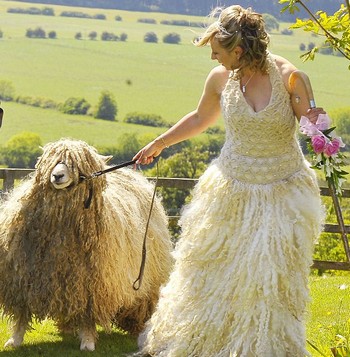
Treehugger told us about a shepherdess who married in her own sheep’s wool! A modern day shepherdess who breeds rare sheep decided to get married in a dress made of the wool from her favorite Lincoln Longwool. The groom wore a wool waistcoat and the article’s writer, Bonnie Altar (surprisingly enough), couldn’t help dubbing them “a tight-knit couple.” These photos are from the Daily Mail.
Then our new friends at HippyShoper.com pointed us toward a simple eco-chic wedding dress , fit for beach nuptials. A clean and simple strapless dress, it’s not only beautifully light and stylish - a simple version of the empire line dresses making waves on the catwalk just now - it’s also ethically made, from 100% organic cotton, under accredited fair trade conditions.
So then we decided to search for some more guilt-free ways to glide down the aisle. We found a great article from Oko Organic Clothing and chose some of our favorites to share with you.
Their fabrics are all hemp blends, chosen for their aesthetic beauty, drape and texture. For the pure Vegan bride, they have a hemp/tencel blend. All of their fabrics are comparable to, and may actually surpass, traditional bridal fabrics.
At Conscious Clothing they believe that by choosing to wear natural fiber on your special day, you are honoring not only the sacredness of your commitment, but also the very sacred connection that we all share with our planet.
Adele Wechsler designs for “the bride who cares about the world in which she lives”. Her Eco Couture collections show off her eco-conscience by infusing elements like organic hemp and silk, vegetable dyes, remnant fabrics, and hand cut designs.
Morgan Boszilkov presents the Natural Bridal Collection, are a line of eco-friendly designer wedding gowns, handcrafted with love. She even gives 5% of the profits to environmental causes.
Morgan uses sustainable fabrics and strives to apply green and socially responsible principles to all aspects of her business. She knows that exceptionally designed gowns that are eco-friendly don’t need to sacrifice style or beauty. Morgan believes sustainable fabrics are not limiting, but have endless potential for creating fabulous designs.
Rene Geneva Design – Using hemp silk, these gowns are dyed with low impact dyes, carbon neutral and fair trade.
Conscious Elegance - with the tagline “Kindness made Exquisite”, their mission is to provide the most gorgeous eco-friendly wedding gowns and dresses using only the kindest, most socially responsible methods and to offer them at a fair price.
So when you walk down the aisle on your wedding day, be sure to think of Garments Without Guilt!
Recent Comments